
Introduction #
The Legacy Paradox: Transforming Technical Debt into Strategic Assets
Your legacy systems are the bedrock of your operations, executing millions of transactions with steadfast reliability. However, in a cloud-native landscape, this stability often masks a dangerous rigidity. Many enterprises face the "Legacy Paradox": systems that are too critical to decommission, yet too inflexible to fuel growth.
This inertia is driven by Technical Debt—the compounded interest of quick fixes and deprecated code within your Enterprise Software Engineering portfolio. Industry research indicates that servicing this debt consumes nearly 40% of enterprise IT budgets. Instead of funding innovation, resources are drained by maintenance, forcing teams to tread water rather than move forward.
Critical considerations for your infrastructure:
- Is your vital business intelligence locked in silos, inaccessible to modern analytics?
- Do you hesitate to update core applications because the original architects have moved on, leaving behind undocumented complexities?
Artificial Intelligence (AI) fundamentally alters this calculus. AI is no longer merely a destination; it is the vehicle for modernization itself. We are shifting from modernizing for AI to modernizing with AI. By deploying intelligent algorithms to decode complex environments and drive Business Automation, we drastically de-risk the migration to advanced Cloud Architectures.
At OneCubeTechnologies, we view Legacy Modernization as a strategic evolution, not a gamble. By applying enterprise-grade engineering to your infrastructure, we transform technical debt into a flexible, scalable foundation—positioning your business to define the market, rather than simply survive it.
Strategy 1: Augment and Automate for Immediate ROI #

Strategy 1: Augment and Automate for Rapid ROI
The "Big Bang" migration—decommissioning a critical legacy system overnight to swap it for a new one—is a high-risk gamble that frequently leads to catastrophic downtime. A superior approach is the "Wrap and Extend" strategy. This pragmatic methodology prioritizes immediate business value over architectural perfection, allowing organizations to modernize user experiences and operational efficiency without jeopardizing the core engine.
The Intelligent Wrapper
In Enterprise Software Engineering, modernizing a legacy core does not require demolition. Instead, we construct an intelligent abstraction layer around your existing infrastructure.
By utilizing modern APIs (Application Programming Interfaces) as secure bridges, we expose the data and functionality of your mainframe to external environments without altering the underlying code. Once this bridge is established, Artificial Intelligence can be deployed to handle complex interactions, effectively insulating the legacy system from the demands of modern digital channels.
From Static Bots to Cognitive Agents
While traditional Business Automation, such as Robotic Process Automation (RPA), provides utility, it remains rigid—breaking easily when processes deviate from strict rules. AI introduces Intelligent Process Automation (IPA), transforming static automation into cognitive agents capable of decision-making.
- Computer Vision: Moving beyond simple screen scraping, AI-driven tools can ingest and interpret unstructured data—such as PDF invoices or handwritten forms—regardless of layout, eliminating manual data entry.
- Natural Language Processing (NLP): Where legacy systems demand specific command codes, NLP enables "Intent Recognition." Customers can speak or type naturally (e.g., "I need to file a claim"), and the AI translates that intent into the precise technical commands the legacy system requires.
This approach unlocks siloed data and streamlines complex workflows. For instance, an insurer can automate claim intake by utilizing AI to validate documents and query the mainframe for policy details, reducing processing latency from days to minutes.
OneCube Actionable Intelligence
To successfully augment your core infrastructure, prioritize the following steps:
- Target High-Friction Nodes: Avoid attempting a system-wide wrapper immediately. Identify processes that generate the highest volume of customer friction or require extensive manual intervention. Begin your modernization efforts there.
- Audit Data Accessibility: Verify whether your Cloud Architecture and analytics tools can access live operational data. If visibility is limited, building an API layer solely to extract data for business intelligence is a high-value, low-risk pilot project.
Strategic Imperative: Are you delaying innovation while waiting for a "perfect" system rebuild? Competitors are already leveraging AI to capture market share. At OneCubeTechnologies, we deploy these intelligent wrappers to secure immediate operational wins, buying you the time and budget to fund a deeper transformation toward a scalable, cloud-native architecture.
Strategy 2: AI-Driven Discovery to De-Risk Your Roadmap #
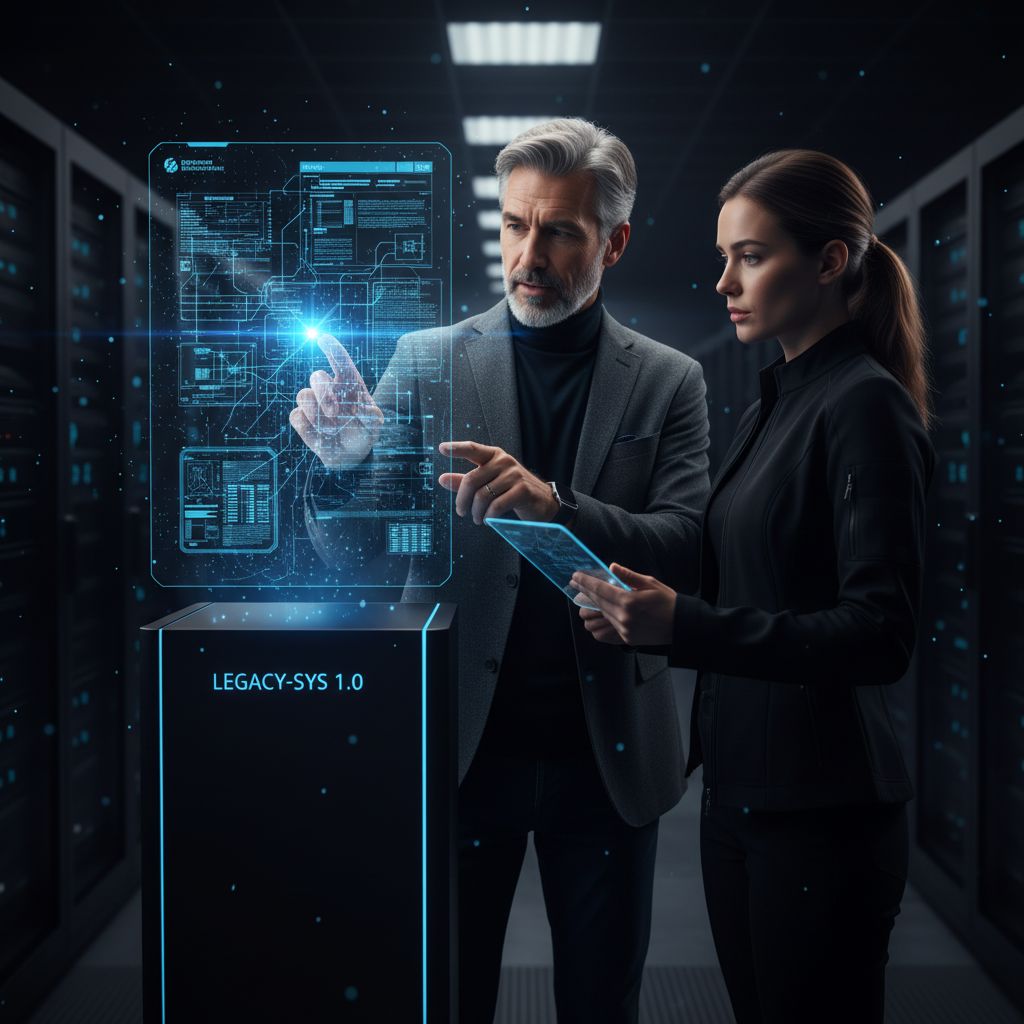
Strategy 2: AI-Driven Discovery to De-Risk Your Roadmap
The primary barrier to Legacy Modernization is not the absence of new technology, but the opacity of existing infrastructure. Many enterprises operate "black box" systems characterized by missing documentation, convoluted logic, and codebases written by architects who have long since retired. IT leaders often hesitate to modify these environments, fearing that touching a single line of code could dismantle a critical "load-bearing wall."
In this context, AI serves as the ultimate forensic instrument. Before writing new code, AI-driven discovery tools can ingest and analyze your entire Enterprise Software Engineering environment—parsing millions of lines of COBOL, PL/I, or other legacy languages in a fraction of the time required by human teams.
Architectural Radiography
This strategy functions as a digital MRI for your software anatomy. AI algorithms map the intricate web of dependencies, visualizing exactly how distinct system modules interact. By simulating changes—such as modifying a pricing algorithm in the billing system—AI can predict which downstream reporting tools might be affected, ensuring a seamless transition to a scalable Cloud Architecture.
Beyond connectivity mapping, AI addresses two critical modernization challenges:
- Extracting Business Logic: Over decades, vital business rules—such as complex loyalty calculations—become encapsulated in hard-coded logic that is no longer fully understood. AI tools identify these rules and translate them into human-readable specifications, ensuring your core business intelligence is preserved during migration.
- Identifying Deprecated Code: Industry analysis suggests that large legacy estates are often bloated with code that is no longer executed. AI identifies this "dead code" with high precision. Eliminating these redundancies before migration significantly reduces the scope, risk, and ongoing operational costs of your new architecture.
OneCube Actionable Intelligence
Knowledge is risk mitigation. Before authorizing a migration, implement these steps to secure your foundation:
- Transition to Automated Discovery: Manual code reviews are slow, cost-prohibitive, and prone to error. Invest in automated, AI-driven discovery tools to audit your codebase. The initial investment is negligible compared to the cost of a failed migration.
- Sanitize Before Migration: Avoid the "lift and shift" of technical debt. Use AI-generated insights to delete dead code and archive unused data prior to re-platforming. Migrating legacy bloat into a modern, cloud-native environment negates the efficiency gains of modernization.
Strategic Imperative: Is your Legacy Modernization budget based on estimation or empirical data? At OneCubeTechnologies, we utilize these discovery protocols to transform architectural ambiguity into certainty, ensuring your roadmap is built on a foundation of engineering reality.
Strategy 3: Re-engineer for a True AI-Native Future #

Strategy 3: Re-engineering for an AI-Native Future
While encapsulation extends system life and discovery mitigates risk, the definitive goal of Legacy Modernization is transformation. We must move beyond "lift and shift"—merely hosting old code on new servers. True modernization requires Re-engineering: fundamentally reconstructing core systems to be "Cloud-Native" and "AI-Native" by design.
Deconstructing the Monolith: The Microservices Paradigm
To understand this shift, visualize your legacy system as a monolithic structure. Altering a single component requires modifying the entire framework, risking systemic failure. This is the limitation of Monolithic Architecture.
Re-engineering involves decomposing this monolith into Microservices. These are autonomous, modular components representing specific business functions—such as Identity Management, Inventory Control, or Payment Processing. Because they are decoupled, teams can upgrade or replace individual services without disrupting the broader ecosystem. This architectural agility is the pulse of modern Enterprise Software Engineering.
Intrinsic Intelligence
In an AI-Native core, artificial intelligence is not a peripheral plugin; it is intrinsic to the architecture.
- Reactive vs. Predictive: Traditional systems record transactions post-factum. An AI-Native system leverages historical data to predict demand, proactively adjusting supply chains before orders are placed.
- Static vs. Dynamic: Legacy banking cores rely on rigid logic. An AI-Re-engineered core executes Machine Learning (ML) models on every transaction in real-time, detecting fraud through behavioral anomalies that static rules overlook.
To sustain this, organizations must adopt MLOps (Machine Learning Operations). Just as DevOps streamlines software delivery, MLOps ensures that the "cognitive" elements—your AI models—are continuously monitored, retrained, and optimized against evolving market data.
OneCube Actionable Intelligence
Re-platforming is a strategic campaign, not a quick fix. To succeed in this final stage, prioritize the foundation:
- Data as Infrastructure: Intelligent architectures cannot function on compromised data. Before re-engineering, invest in a robust data platform within your Cloud Architecture. Microservices require clean, standardized data to train ML models effectively. Without high-fidelity data, AI outputs become liabilities rather than assets.
- The "Strangler Fig" Pattern: Avoid the high-risk "Big Bang" rewrite. Identify the edges of your monolith—such as notification services or reporting modules—and systematically replace them with modern microservices. Over time, the new, scalable architecture supplants the legacy system, allowing for a seamless transition with zero downtime.
Strategic Imperative: Is your infrastructure built for storage or intelligence? Are you merely archiving data, or leveraging it for split-second decision-making? At OneCubeTechnologies, we design architectures that do not simply operate your business—they learn from it, ensuring you remain competitive in an era where adaptability is the ultimate currency.
Conclusion #
Conclusion: From Maintenance to Market Leadership
The traditional dichotomy between operational stability and digital innovation is obsolete; Artificial Intelligence now enables the convergence of both. We have navigated a strategic continuum: leveraging Augmentation for immediate efficiency, utilizing AI Discovery to mitigate risk through empirical data, and executing Re-engineering to establish a scalable architecture that is cloud-native by design.
This evolution in Enterprise Software Engineering transforms IT infrastructure from a static cost center into a dynamic driver of business value. The strategic question is no longer if modernization is necessary, but rather the velocity at which it can be executed. At OneCubeTechnologies, we provide the Cloud Architecture expertise required to transmute legacy technical debt into high-value digital assets, ensuring your business does not just endure the future, but engineers it.
References #
Reference
- Title: Application Modernization Strategies, Author(s): Stefan Van Der Zijden, Deacon D.K Wan, Publication: Gartner (2021), Link: https://www.gartner.com/en/documents/4004163
- Title: From legacy to legendary: A guide to enterprise modernization, Author(s): Google Cloud, Publication: Google Cloud Whitepaper (n.d.), Link: https://cloud.google.com/whitepapers/from-legacy-to-legendary-a-guide-to-enterprise-modernization
- Title: Application Modernization with AI: From Business Rule Mining to Refactoring, Author(s): Ruchir Puri, Publication: IBM Research Blog (2020), Link: https://research.ibm.com/blog/application-modernization-with-ai
- Title: The high cost of technical debt, Author(s): T. Klein, S. Young, C. Hiser, L. Sin, W. Brown, Publication: McKinsey & Company (2020), Link: https://www.mckinsey.com/capabilities/mckinsey-digital/our-insights/the-high-cost-of-technical-debt
- Title: Intelligent automation: A new era of innovation, Author(s): David Schatsky, Craig Muraskin, Ragu Gurumurthy, Publication: Deloitte Insights (2017), Link: https://www2.deloitte.com/us/en/insights/focus/cognitive-technologies/intelligent-automation-a-new-era-of-innovation.html